10 Reasons Why Mobile-Friendly Web Design Is Important for New York Businesses in 2026
New York is one of the most competitive business markets in the United States. Whether you run a ...
Date: September 10, 2026


📅 Updated on: August 31, 2026
Understanding the website development timeline is important for any business planning a new website or a complete website redesign. Building a business website is no longer a simple matter of putting a few pages online and adding a contact form. A modern website needs to look professional, work smoothly on mobile devices, load quickly, provide a good user experience, support search engine optimization, and make it easy for visitors to become customers.
So, how long does it take to build a business website?
For most small and medium-sized businesses, a professional website can take anywhere from 3 to 12 weeks to design, develop, test, and launch. A relatively simple brochure website may be completed in 3–5 weeks, while a larger custom website with advanced functionality, integrations, e-commerce, or custom applications can take several months.
The exact website development timeline depends on several factors, including the number of pages, design requirements, content availability, technology, functionality, SEO requirements, revisions, and the experience of the development team.
If you are planning a new business website or considering a website redesign, understanding the development process can help you set realistic expectations, control costs, and avoid unnecessary delays.
A website development timeline is the estimated schedule for taking a website from the initial idea to a fully functional, tested, and launched website.
A typical project includes several stages:
Although these stages are generally completed in order, some activities can happen simultaneously.
For example, SEO research can begin while the design is being created, while content can be prepared during development. This can shorten the overall timeline when a project is well managed.
The most important thing to understand is that website development time is not determined only by the number of pages. A five-page website with complicated functionality can take longer than a 20-page website with straightforward content.
There is no single timeline that applies to every business website.
Here is a general estimate:
| Website Type | Typical Development Time |
|---|---|
| Basic landing page | 1–2 weeks |
| Small business website | 3–6 weeks |
| Professional corporate website | 5–10 weeks |
| E-commerce website | 6–16+ weeks |
| Custom web application | 3–9+ months |
| Large enterprise website | 3–12+ months |
A simple small business website may contain five to ten pages, such as:
However, if the website requires customer accounts, payment processing, booking systems, third-party integrations, advanced search, personalized dashboards, or custom business logic, the development timeline increases considerably.

Understanding each stage makes it easier to understand why professional website development takes several weeks rather than a few days.
The first stage is planning.
Before writing code or designing pages, the development team needs to understand the business, target audience, competitors, goals, and technical requirements.
During this stage, you may determine:
For example, a New York law firm may need a completely different website structure from a New York restaurant, construction company, dentist, consultant, or e-commerce business.
Good planning can prevent expensive changes later.
Once the project requirements are clear, the next step is creating the sitemap.
A sitemap defines the hierarchy of the website.
For example, a typical business website might have the following structure:
About
Portfolio
Blog
→ Blog Article
Contact
A well-planned structure helps visitors navigate the website and also gives search engines a better understanding of the relationship between pages.
This is where SEO and web development begin to overlap.
Creating a logical website structure before development can reduce future SEO problems and make the website easier to expand.
Content is one of the biggest factors affecting the website development timeline.
A development team can build the technical structure, but the website still needs useful content.
This may include:
If the client already has finalized content, development can move much faster.
If content needs to be written, edited, approved, optimized, and uploaded during the project, the timeline can increase.
Businesses should therefore prepare their content as early as possible.
The design stage determines how the website will look and how users will interact with it.
A professional website design typically includes:
The designer may first create wireframes and then develop high-fidelity page designs.
For a small website, the design phase might take one to two weeks.
Larger websites can require significantly more time because multiple page types and user journeys need to be designed.
A visually attractive website is not automatically an effective website.
Visitors should quickly understand:
Good UX reduces friction and helps turn website visitors into leads or customers.
This is where the approved design is converted into a working website.
Developers create:
The technology selected can have a major effect on the development timeline.
For example, a WordPress website using an appropriate theme and plugins can often be developed faster than a fully custom website.
However, custom development can provide significantly more control when the business has unique requirements.
One of the most important decisions businesses make is choosing between WordPress and custom development.
WordPress is widely used because it provides a flexible content management system and a large ecosystem of themes and plugins.
WordPress can be a good choice for:
A standard WordPress business website can sometimes be completed within 3–6 weeks, depending on its complexity.
Custom development gives developers greater control over functionality, architecture, user experience, and integrations.
It can be appropriate when a company needs:
Custom development generally takes longer because more components need to be designed and built specifically for the business.
The choice should not simply be based on development speed. Businesses should consider long-term requirements, scalability, maintenance, security, performance, and total cost.
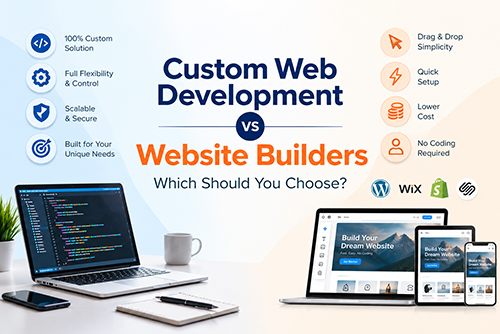
Another common decision is choosing between custom web development and a website builder.
Website builders can be useful for individuals and businesses that need a simple online presence quickly.
They can offer:
However, businesses may eventually encounter limitations involving customization, performance, integrations, or advanced functionality.
Custom web development vs website builder is therefore not simply a question of which option is faster.
A website builder may be faster initially, but custom development may be more suitable when the website is expected to become an important part of the business.
For a business that expects significant growth, generating leads through organic search, integrating multiple systems, or developing unique online services, investing in a more flexible platform can make sense.
Today, a website cannot be designed only for desktop computers.
Users may visit your website using:
This makes mobile-friendly web design essential.
Developers need to ensure that layouts automatically adapt to different screen sizes.
They also need to test:
A page that looks excellent on a large monitor can become difficult to use on a smartphone if it is not properly responsive.
Mobile optimization should therefore be included in the development process rather than treated as an optional final step.
SEO should not be added only after the website has launched.
SEO and web development work together from the beginning.
Technical and on-page SEO considerations can include:
Keyword research should also influence the website structure.
For example, if a company provides several services, creating dedicated service pages can provide more opportunities to target relevant search terms.
SEO implementation can be completed during development, which can prevent problems after launch.
Before launch, the website needs to be thoroughly tested.
Developers and QA specialists may check:
The website should be tested across common:
Testing should also identify:
The team should check:
Testing is important because launching a website with broken forms, missing pages, or mobile usability problems can negatively affect both users and the business.
Once the website reaches a review stage, the client gets an opportunity to provide feedback.
Common revision requests include:
The number of revision rounds can significantly affect the website development timeline.
One or two organized rounds of feedback are usually much easier to manage than continuous changes throughout development.
Businesses can speed up projects by collecting feedback from all decision-makers before sending it to the development team.
Once the website has passed testing and received final approval, it can be launched.
The launch process may involve:
The actual technical launch may take only a few hours, but the preparation leading up to launch is much more important.
For many small businesses, a realistic timeline looks like this:
| Stage | Estimated Time |
|---|---|
| Discovery | 2–5 days |
| Sitemap | 1–3 days |
| Content | 1–3 weeks |
| Design | 1–3 weeks |
| Development | 1–6 weeks |
| SEO | 3–10 days |
| Testing | 3–7 days |
| Revisions | 3–10 days |
| Launch | 1–2 days |
Some of these activities overlap.
Therefore, adding all the maximum numbers together does not necessarily mean the project will take six months.
A well-managed small business project can often be completed in 3–6 weeks.
A more complex website may take 6–12 weeks or longer.
If you are also planning your website budget, see our guide to website development costs in New York in 2026, which breaks down typical costs by website type, functionality, and development approach.

Several factors can increase the website development timeline.
If developers are waiting for content, images, or product information, the project can stop.
Changing the design after development has started can require additional development work.
If functionality is not defined at the beginning, new requirements can appear later.
Connecting a website to CRM systems, payment gateways, inventory systems, email platforms, APIs, or booking software can add development time.
More pages mean more content, layouts, testing, and SEO work.
Projects can move slowly when several stakeholders need to approve every change.
Unique features generally take longer to build and test than standard website components.
Website development timelines and budgets often go hand in hand. Once you understand how long development takes, the next question is usually how much website development costs in New York.
There is no universal price because the cost depends on the scope and complexity of the project.
A basic business website may cost considerably less than a custom e-commerce platform or web application.
Factors affecting website development cost include:
Businesses should avoid choosing a development company based only on the lowest quote.
A very low initial price can sometimes mean limited customization, minimal testing, poor SEO implementation, or additional charges later.
Instead, compare the actual scope of work and expected business outcome.
The WordPress website cost New York businesses pay can also vary depending on requirements.
A simple WordPress website using an existing theme and standard functionality can be relatively affordable.
A professionally customized WordPress website can cost more because it may involve:
Therefore, businesses should request a detailed proposal that clearly explains what is included.
Instead of asking only, “How much does a WordPress website cost?”, consider asking:
What functionality, design, content, SEO, support, and maintenance are included in the price?
That gives you a much more useful comparison.
Selecting the right web development company New York businesses can work with is another important part of the project.
Look for a company that can demonstrate:
Ask potential developers to explain their process.
A professional agency should be able to tell you:
This can help you identify potential delays before signing a contract.
A business website does not need every possible feature.
Instead, focus on features that help customers and support business goals.
Important small business website features may include:
Depending on the business, additional features might include:
The goal is not to add as many features as possible.
The goal is to add the right features.
Every additional feature can increase development time, testing requirements, maintenance, and potentially cost.
A website redesign can take anywhere from a few weeks to several months depending on how much of the existing website is being replaced.
A minor redesign may involve:
A major redesign may involve:
A redesign can therefore be almost as complex as building a new website.
One important consideration is SEO.
If existing pages receive organic traffic or backlinks, URLs should not be changed without proper planning.
Redirects and SEO migration should be handled carefully to minimize the risk of losing search visibility.
If you want your website launched faster, preparation is extremely important.
Have your text, images, logos, and other assets ready before development begins.
Create a clear list of required pages and functionality.
Having one person coordinate feedback can significantly reduce delays.
Set realistic deadlines for reviewing designs.
Adding major features halfway through development can affect both cost and schedule.
Choose WordPress, custom development, or another platform based on your actual business requirements.
Integrating SEO during development is more efficient than fixing structural problems after launch.
SEO should not be added only after the website has launched. Search engines recommend building websites that are useful, accessible, and easy for search engines to understand. You can review Google’s SEO Starter Guide
When building a website, businesses often want all three:
In practice, there are usually trade-offs.
A website can be launched very quickly using a template or website builder, but customization may be limited.
A highly customized website may provide a better long-term experience but require more time and investment.
The best approach is to determine which factors matter most for your business.
For a small local company, launching a professional five-to-ten-page website within a month may be more valuable than spending six months developing unnecessary functionality.
For a company building an online marketplace, SaaS platform, or complex e-commerce system, additional development time may be necessary.
Not necessarily.
A fast development process is valuable, but rushing can create problems.
Skipping proper:
can lead to problems after launch.
A website should be launched when it is ready, not simply because a deadline has arrived.
The objective should be to create a website that works well for customers and supports the business for years.
A simple five-page website can often take approximately 3–5 weeks, assuming content and feedback are provided promptly.
A standard WordPress business website can often take 3–6 weeks. Custom WordPress functionality can increase the timeline.
Custom websites can take anywhere from 6–12 weeks to several months, depending on functionality and complexity.
Technically, yes. A very simple website or landing page can be created quickly. However, a professional business website involving custom design, content, SEO, testing, and revisions generally requires more time.
The most common causes are delayed content, unclear requirements, frequent revisions, complex integrations, additional functionality, and slow approval processes.
SEO can add some work to the project, but incorporating SEO during development is generally more efficient than fixing technical and structural issues after launch.
It depends on your requirements. WordPress can be excellent for many business websites, while custom development may be better when the website requires unique functionality or complex integrations.
So, how long does it take to build a business website?
For many small businesses, a realistic website development timeline is approximately 3–6 weeks for a professional website.
More complex websites can take 6–12 weeks or longer, while large custom platforms may require several months of development.
The timeline ultimately depends on the project scope rather than simply the number of pages.
Before starting your project, clearly define:
If you are comparing the custom web development vs website builder approach, consider not only how quickly you can launch but also what your business will need six months, one year, or three years from now.
Likewise, when comparing the website development cost New York companies quote, look beyond the initial price. Evaluate the complete scope, technology, SEO, mobile experience, security, testing, support, and long-term maintainability.
A successful business website is more than an attractive collection of pages. It is a digital asset designed to attract visitors, communicate your value, generate leads, and support business growth.
The right development process balances time, cost, functionality, SEO, user experience, and quality.
By understanding the website development timeline before starting, you can make better decisions, prepare your content and resources in advance, reduce unnecessary delays, and launch a website that is ready to serve your customers.
Need our services: Request a Quote
New York is one of the most competitive business markets in the United States. Whether you run a ...
Date: September 10, 2026
Choosing how to build a website is one of the most important decisions a business can make when e...
Date: September 6, 2026

If you are planning to build a business website in New York, one of the first questions you are l...
Date: September 2, 2026

Discover 10 essential small business website features for 2026, including mobile design, SEO, sec...
Date: August 29, 2026