10 Reasons Why Mobile-Friendly Web Design Is Important for New York Businesses in 2026
New York is one of the most competitive business markets in the United States. Whether you run a ...
Date: September 10, 2026

📅 Updated on: September 6, 2026
Choosing how to build a website is one of the most important decisions a business can make when establishing or improving its online presence. Today, businesses have more options than ever before. You can launch a website quickly using a drag-and-drop website builder, or you can work with a professional development team to create a completely customized website.
But which option is right for your business?
The debate around custom web development vs website builder usually comes down to several factors, including budget, functionality, design flexibility, scalability, SEO, performance, security, maintenance, and long-term business goals.
Website builders can be attractive because they make it possible to create a website without extensive technical knowledge. They are often affordable, relatively quick to launch, and suitable for simple websites. However, custom web development provides significantly more control over functionality, design, integrations, performance, and future growth.
The right choice depends less on which option is “better” and more on what your business actually needs.
In this guide, we’ll compare custom web development and website builders in detail and help you determine which approach makes sense for your organization.
Custom web development involves creating a website specifically around a company’s requirements rather than adapting the business to an existing template.
A custom website may include individually designed interfaces, custom functionality, database architecture, API integrations, customer portals, booking systems, ecommerce functionality, dashboards, third-party integrations, and other features developed specifically for the business.
Unlike a basic template-based website, custom development gives businesses greater control over the website’s underlying architecture and functionality.
For example, a company may need:
These requirements may be difficult or inefficient to implement using a standard website builder.
Professional web development teams can select technologies and architecture based on the project’s requirements rather than forcing the business to work within the limitations of a particular platform.
E Pixel Services, for example, offers custom website development alongside ecommerce development, WordPress and CMS development, SaaS development, landing page development, and legacy modernization.
A website builder is a platform that allows users to create websites using prebuilt templates, visual editors, drag-and-drop functionality, plugins, widgets, and predefined components.
Popular website-building platforms can be useful for individuals, startups, freelancers, small businesses, and organizations that need a relatively simple online presence without investing heavily in development.
Website builders generally simplify several technical tasks, including:
Modern AI-powered website builders have made the process even faster. Recent website-builder platforms can generate layouts, content, branding elements, and website structures from simple instructions.
This convenience is one of the biggest reasons website builders remain popular.
However, convenience can also come with limitations.
Before deciding which approach is right for you, it helps to compare the two options across the areas that matter most to a business.
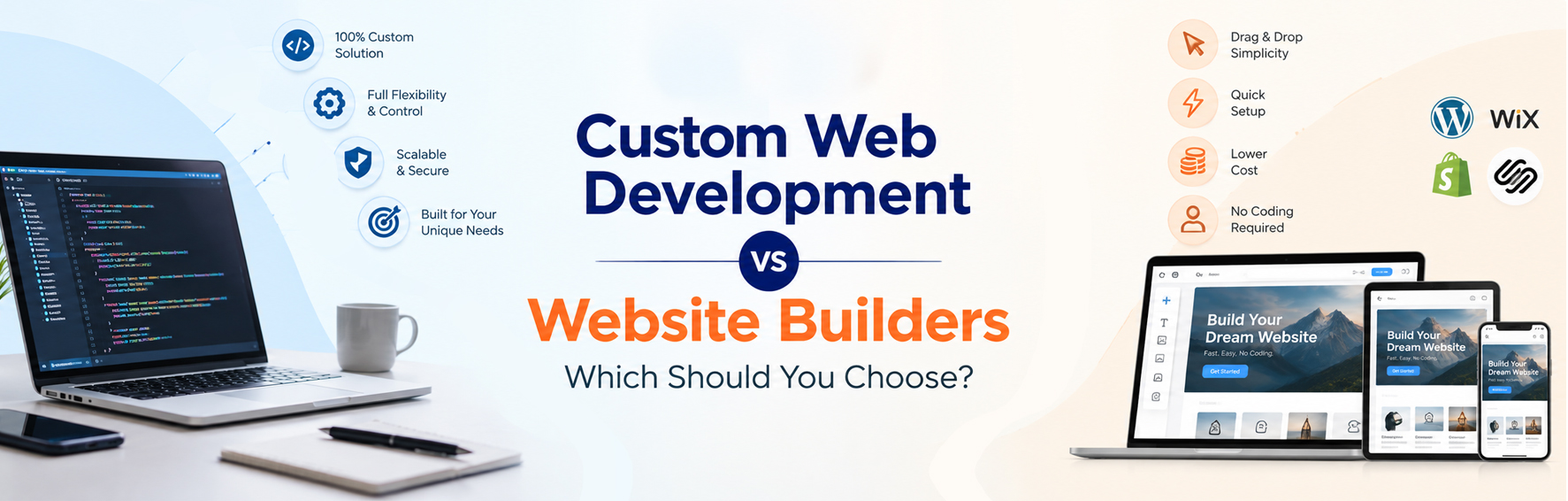
| Factor | Custom Web Development | Website Builder |
|---|---|---|
| Initial Cost | Usually higher | Usually lower |
| Development Time | Longer | Faster |
| Design Flexibility | Very high | Moderate to high |
| Custom Functionality | Excellent | Limited by platform |
| Scalability | Excellent | Platform dependent |
| SEO Control | High | Depends on platform |
| Performance Optimization | High control | Limited control |
| Integrations | Highly flexible | Usually plugin/app dependent |
| Maintenance | Requires technical support | Often simplified |
| Technical Knowledge | Usually required | Minimal |
| Long-Term Flexibility | Excellent | Moderate |
| Ownership/Portability | Depends on architecture | Often platform dependent |
Let’s examine each factor in more detail.
Before deciding between a website builder and custom development, it is also important to understand the factors that influence the overall website development cost. Development complexity, design requirements, integrations, technology, ecommerce functionality, and ongoing maintenance can all affect the final investment.
Cost is often the first consideration when comparing custom web development vs website builder.
Website builders generally have a lower starting cost because many technical components are already included. Instead of paying developers to create a website from scratch, you can choose a template, customize it, add your content, and publish the site.
This can make website builders attractive for:
However, the initial price doesn’t always represent the total cost of ownership.
A business may eventually need premium plugins, additional applications, specialized integrations, higher hosting plans, professional design assistance, SEO services, security tools, or developer support.
Custom development usually requires a larger initial investment because the website is designed and developed specifically for the organization.
For businesses with complex requirements, however, that investment may provide greater long-term value.
A custom website can be built around the company’s actual workflow instead of requiring employees to adapt their processes to a platform.
Usually, yes—at least initially.
But “more expensive” doesn’t necessarily mean “less valuable.”
For example, consider a company that needs a customer portal integrated with its CRM and payment system.
A website builder may appear cheaper initially, but if the required functionality requires multiple third-party services and workarounds, the total cost can increase over time.
Custom development can provide a more direct solution.
The important question is therefore not:
“Which option is cheaper?”
Instead, ask:
“Which option provides the best value for my business requirements over the next three to five years?”
Design is another major difference between custom development and website builders.
Website builders typically provide a collection of templates. These templates can often be customized with different colors, fonts, images, layouts, sections, and components.
For many businesses, this is enough.
But customization has limits.
You may eventually encounter situations where the exact layout you want isn’t supported by the builder.
Custom web development offers much greater design freedom.
A development team can create:
This can be particularly important for established brands that need their website to look significantly different from competitors.
A custom website can also be designed around the user’s journey instead of starting with a template and modifying it.
This is one of the strongest arguments for custom web development.
Website builders are excellent when your requirements fit within the platform’s existing ecosystem.
For example, you may need:
Most website builders can handle these requirements.
The situation changes when you need business-specific functionality.
Imagine a company that needs a platform where:
This isn’t simply a marketing website.
It is effectively a web application.
A custom development approach may therefore be much more appropriate.
Custom development allows developers to create functionality specifically around the organization’s workflows.
Scalability is often overlooked when businesses first build a website.
A website that works perfectly for 100 visitors per day may need a very different architecture when it receives thousands of visitors or begins processing significant amounts of data.
Website builders can scale to varying degrees depending on the platform, hosting infrastructure, plan, and type of website.
However, businesses can eventually encounter platform limitations.
Custom web development gives businesses greater control over:
This can be especially important for:
If you expect your website to become an important operational system for your business, scalability should be considered from the beginning.
SEO is another important consideration.
A common misconception is that custom websites automatically rank better than websites created with builders SEO-friendly website development.
That’s not necessarily true.
Search rankings depend on many factors, including content quality, relevance, technical implementation, authority, user experience, links, structured data, and other signals.
Google recommends creating helpful, reliable, people-first content rather than producing content primarily to manipulate search rankings.
Both custom websites and website-builder websites can perform well in search results when properly implemented.
However, custom development can provide greater technical control.
Developers can control elements such as:
Website builders may provide many of these features through built-in tools or plugins, but the amount of control depends on the platform.
For businesses investing heavily in SEO, having control over the underlying website architecture can become increasingly valuable.
Website performance affects user experience, conversions, and potentially SEO-related considerations.
A slow website can frustrate visitors and increase the likelihood that they leave before completing an important action.
MDN recommends several performance practices, including minimizing unnecessary JavaScript, optimizing images, compressing resources, using appropriate resource hints, and considering CDNs where appropriate.
Custom development can provide more opportunities to optimize performance because developers have greater control over the code and architecture.
For example, a custom website can be designed with:
Website builders have improved considerably, and many provide good performance out of the box. However, developers may have less control over platform-level code and infrastructure.
Therefore, for performance-critical projects, custom development can offer an advantage.
Security should be considered regardless of which development approach you choose.
Website builders typically handle many infrastructure-level responsibilities for users, which can make security management easier for non-technical users.
However, businesses still need to consider:
With website development company in the USA, security becomes more dependent on the development team, hosting environment, code quality, update procedures, and ongoing maintenance.
A professional development process should incorporate security considerations throughout the project rather than treating security as an afterthought.
For organizations handling sensitive customer information, payment-related workflows, or business-critical data, security architecture should be considered before development begins.
Modern businesses rarely operate using a website alone.
A website may need to communicate with:
Website builders often provide integrations through plugins, extensions, apps, or APIs.
This is perfectly suitable when a supported integration exists.
But what happens when your company uses proprietary software?
Or when the integration requires a specific workflow?
Custom web development provides much greater flexibility.
Developers can create custom APIs and integration layers designed around the company’s systems.
This can eliminate manual data entry and improve operational efficiency.
Website builders generally simplify maintenance.
The platform provider may handle aspects of:
This can be a significant advantage for small businesses that don’t have technical employees.
Custom websites require more active maintenance.
Depending on the technology used, maintenance may involve:
However, professional web development companies can provide ongoing maintenance and support.
The key is to understand who will maintain the website after launch.
One important question businesses should ask is:
“What happens if I want to move my website somewhere else?”
Website builders can create some level of platform dependency.
Your website may rely heavily on the builder’s hosting, themes, components, applications, or infrastructure.
If you eventually want to migrate to another platform, migration may not always be straightforward.
Custom development can provide more control over your application’s code, hosting environment, databases, and infrastructure.
However, ownership terms still depend on your development agreement.
Before starting a project, businesses should clarify:
These questions can prevent major problems later.
 Website Builder vs Custom Website Development
A website builder can be the right choice if your business needs a relatively simple website and your primary priorities are speed, affordability, and ease of management.
Consider a website builder if:
If you’re launching a business and need an online presence quickly, a website builder can provide a cost-effective starting point.
A website builder can be ideal for a basic:
If you don’t have a developer and want to update pages, images, and content independently, a website builder can make that easier.
Templates and drag-and-drop interfaces can significantly reduce development time.
If your website doesn’t require sophisticated custom systems, the limitations of a builder may not matter.
Custom development becomes more attractive as your requirements become more specialized.
Consider custom web development if:
If your website generates leads, processes orders, manages customers, or supports business operations, customization can become extremely valuable.
If your business has requirements that don’t fit standard plugins or applications, custom development may be necessary.
Businesses that need multiple systems to communicate with one another can benefit from custom development.
If you’re building a platform that you expect to scale substantially, architecture should be designed with future growth in mind.
High-traffic websites and web applications often require greater control over performance.
If customer experience is a major competitive advantage, a custom-designed website can help differentiate your brand.
If customers need accounts, dashboards, transactions, workflows, or complex data interactions, you’re moving beyond a basic website.
There isn’t one universal answer.
A small business selling local services may not need a highly customized platform.
For example, a local cleaning company may primarily need:
A website builder or CMS-based website may be perfectly adequate.
However, consider a growing home-services company that wants customers to:
The requirements are now significantly more complex.
A custom solution may provide much greater value.
The size of the business isn’t the deciding factor.
The complexity of the business requirements is.
If SEO is a major part of your marketing strategy, don’t automatically assume that custom development is the only option.
A properly configured website builder can rank.
The more important question is whether the platform provides enough control for your SEO strategy.
You should evaluate:
Google’s SEO documentation emphasizes understanding how users search and creating helpful, reliable content for them.
Therefore, your development decision should support both technical SEO and a sustainable content strategy.

Another common misconception is that choosing custom development means building everything from scratch.
That’s not necessarily true.
Custom development can be performed using platforms such as WordPress, WooCommerce, Shopify, or other technologies.
For example, a WordPress project can involve:
E Pixel Services lists WordPress, custom CMS development, Shopify, WooCommerce, BigCommerce, Magento, PHP, React, Next.js, Node.js, and other technologies among its development capabilities.
The important distinction is between using a platform and being limited by a platform.
A professional development team can use an established platform while still customizing the experience around the business.
Businesses don’t always have to choose between “completely custom” and “completely DIY.”
A hybrid approach can provide the best of both worlds.
For example, a company might use:
This approach provides the convenience of an established CMS while allowing substantial customization.
The best technology stack should therefore be selected based on business requirements rather than trends.
Before deciding between custom development and a website builder, ask yourself these questions:
Is it simply informational, or will it become part of your business operations?
Will a template satisfy your design requirements?
Write down all required features now and those you expect to need within the next few years.
Consider your CRM, payment systems, marketing platforms, accounting software, and other tools.
If organic traffic is a major acquisition channel, evaluate the platform’s SEO capabilities carefully.
Think about both current and future traffic.
Determine whether your internal team can handle maintenance or whether you need a development partner.
A website built for a six-month campaign may have very different requirements from a platform intended to support your business for the next decade.
A professional web development agency does more than write code.
A good agency should help translate business requirements into a practical technical solution.
The process can include:
This structured approach can reduce the risk of building a website that looks attractive but doesn’t solve the business problem.
E Pixel Services describes its website development process as a structured workflow designed to improve efficiency and minimize operational costs, while offering custom websites, responsive design, ecommerce development, CMS development, SaaS development, landing pages, and legacy modernization.
For businesses considering professional development, you can learn more about E Pixel Services’ website development agency services in the USA.
Choosing the wrong development approach can become expensive.
Imagine launching a website using a builder because it is inexpensive.
Six months later, your business needs:
You may then discover that your original platform cannot efficiently support these requirements.
You could end up rebuilding the website.
This means paying twice.
On the other hand, choosing a highly customized solution for a simple five-page business website can also be unnecessary.
You may spend significantly more money and time than required.
The goal isn’t to choose the most sophisticated technology.
The goal is to choose the simplest technology that can reliably support your current and expected future requirements.
No website is truly “future-proof.”
Technology changes.
Customer expectations change.
Search engines change.
Business models change.
However, you can build a website that is easier to adapt.
A scalable website architecture should make it reasonably straightforward to:
This is where custom development can provide a significant advantage.
Instead of starting with a fixed template and continually working around its limitations, you can create an architecture that supports your business roadmap.
So, custom web development vs website builder — which should you choose?
The answer depends on your goals.
Choose a website builder when you need a simple website, have a limited budget, want to launch quickly, and don’t require extensive customization.
Choose custom web development when your website is strategically important, requires unique functionality, needs multiple integrations, demands greater performance control, or is expected to grow into a more complex digital platform.
For many businesses, the decision can be summarized like this:
Choose a website builder for simplicity.
Choose custom development for flexibility and control.
Choose a professional development team when your website is a critical part of your business.
Most importantly, don’t make your decision based solely on the initial development price.
Consider the total cost, expected growth, maintenance requirements, customer experience, SEO strategy, integrations, security, and long-term business objectives.
A website isn’t simply a digital brochure. For many businesses, it is a marketing channel, sales tool, customer-service platform, operational system, and important part of the brand.
That’s why the right development approach should be based on what the website needs to accomplish.
If you’re evaluating whether your business needs a template-based website, CMS solution, ecommerce platform, or fully customized web application, explore E Pixel Services’ website development services in the USA to learn about available custom development options.
Not always. Custom development offers greater flexibility, control, scalability, and customization, while website builders are generally faster and easier to manage. The better option depends on your requirements, budget, and long-term goals.
Usually, a website builder has a lower initial cost. However, the long-term cost depends on subscriptions, plugins, integrations, maintenance, redesigns, and business requirements.
Yes. Websites built with website builders can perform well in search engines when they have useful content, sound technical implementation, good page experience, and an effective SEO strategy.
The timeline varies considerably. A relatively simple custom business website may take weeks, while ecommerce platforms, portals, SaaS products, and complex web applications can require substantially more development time.
In many cases, yes, but the difficulty depends on the platform, content structure, database, integrations, and ownership of the underlying assets. If future migration is likely, consider this before selecting a platform.
Custom development can provide greater control over performance optimization, but custom code does not automatically mean a faster website. Performance depends on architecture, hosting, code quality, images, scripts, databases, caching, and many other factors.
It depends on the startup’s product and business model. A simple startup website may be perfectly suited to a website builder or CMS. A startup building a SaaS product, marketplace, booking platform, or complex customer portal will generally benefit from custom development.
For readers who want to learn more about website development, SEO, accessibility, and performance, the following resources are useful:
The debate over custom web development vs website builder isn’t really about finding one universally superior solution.
It’s about matching technology to business needs.
If you need a simple website that can be launched quickly and managed easily, a website builder may be the smartest choice.
If you need a website that can support unique workflows, advanced integrations, complex functionality, high performance requirements, or long-term growth, custom web development may be the better investment.
Before making a decision, evaluate your goals, budget, functionality, SEO requirements, scalability, integrations, security, maintenance, and future plans.
If you’re unsure whether your business needs a website builder, CMS, ecommerce platform, or fully customized web application, explore our custom website development services in the USA or contact our team to discuss your requirements.
Need our services: Request a Quote
New York is one of the most competitive business markets in the United States. Whether you run a ...
Date: September 10, 2026

If you are planning to build a business website in New York, one of the first questions you are l...
Date: September 2, 2026

Understanding the website development timeline is important for any business planning a new websi...
Date: August 31, 2026

Discover 10 essential small business website features for 2026, including mobile design, SEO, sec...
Date: August 29, 2026